The Liberty Bell Crack
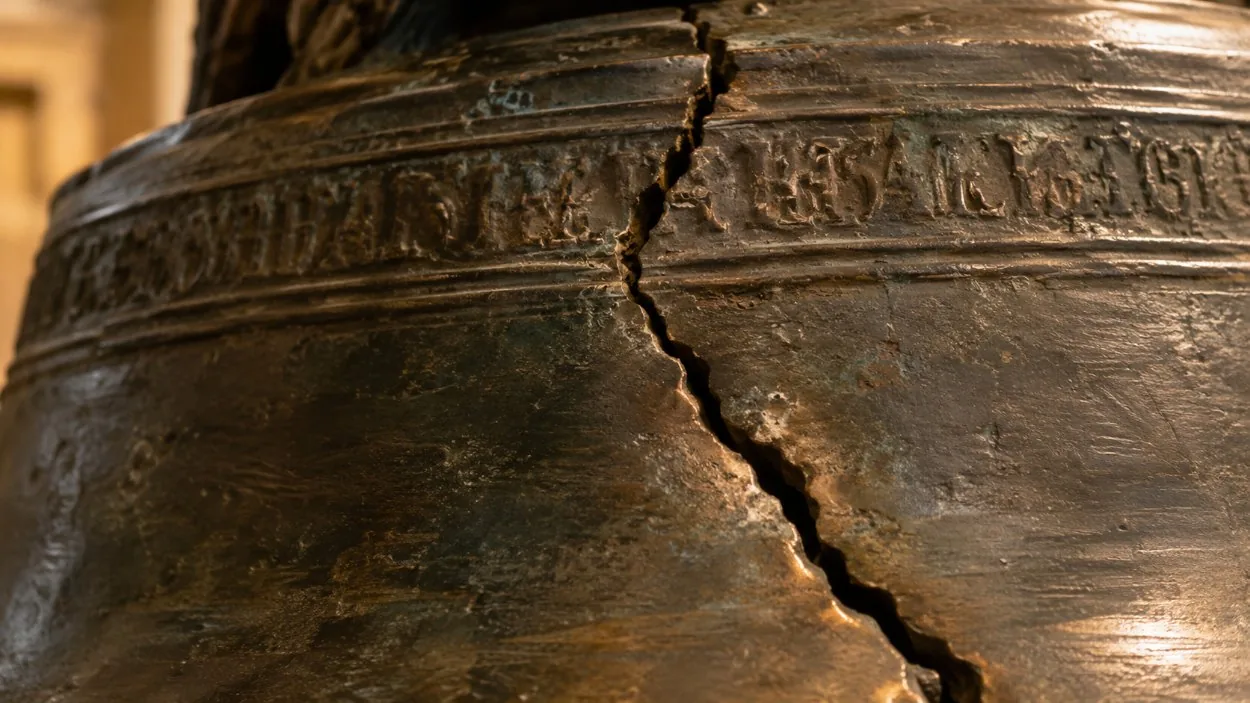
Two bells, two cracks
The bell on display is not the first one. The original, cast at the Whitechapel Foundry in London and ordered in 1751, cracked on first use, according to the NPS. John Pass and John Stow melted it down and cast a new bell in Philadelphia, completed in 1753. The famous crack belongs to that second bell. The history page covers the full story.
When and why it cracked
The exact cause is not known. The NPS says the crack developed in the early 1840s, after about 90 years of use. Wikipedia is less precise and places its origin "sometime between 1817 and 1846". Either way, by the 1840s the bell had cracked. The metal is bronze of about 70% copper and 25% tin, with small amounts of lead, gold, arsenic, silver and zinc, per the NPS; the materials page has more.
The 1846 repair
In 1846 an attempt was made to keep the bell usable. According to Wikipedia, the repair meant "having the sides of the crack filed", so that the edges would stop vibrating against each other when the bell was struck. That filing is the broad, straight-sided gap visible on the bell today. It is the repair, not the crack itself.
February 1846: the last ringing
The repaired bell was rung for Washington’s Birthday in February 1846 (Wikipedia gives 23 February). During that ringing, the NPS says, a second crack extended "from the abbreviation for 'Philadelphia' up through the word 'Liberty'", and this "silenced the bell forever". That second crack is a thin line, harder to spot than the filed gap.
How many cracks are there?
There are two marks to look for. The first is the wide, filed gap from the 1846 repair. The second is the thin hairline crack that the NPS describes running up through the word "Liberty", the one that ended the bell’s ringing. So the usual answer is one visible, widened repair gap plus one thin crack, with the first bell’s crack of the 1750s as an earlier chapter.
Why it was never fixed
The 1846 repair attempt failed, and after that the bell was kept as it is, as a symbol. It has not been rung since. It is still marked each July 4, when descendants of the signers of the Declaration tap it 13 times, once for each of the 13 original colonies. The ringing page explains the difference between tapping and ringing.
Seeing the crack
The bell is displayed in the Liberty Bell Center, 526 Market Street, free and first come, first served, daily from 9 am to 5 pm, per the Liberty Bell Center page on nps.gov. Visitors cannot touch it. It can also be seen through the windows on Chestnut Street at any hour, although the detail is clearer inside. The NPS lists a visit at 15 to 55 minutes, plus the wait, and security screening closes shortly before 5 pm. The Liberty Bell Center page covers the visit itself.
The thin second crack is easiest to follow by finding the word "Liberty" on the bell first and then tracing the line through it.
Frequently asked questions
How did the Liberty Bell crack?
The NPS says it cracked in the early 1840s after about 90 years of use; the exact cause is not known. A second crack appeared when it was rung in February 1846.
How many cracks does the Liberty Bell have?
Visitors see a wide gap, which is the filed 1846 repair, and a thin crack that the NPS describes running up through the word "Liberty".
Why was the Liberty Bell never repaired?
The 1846 repair attempt failed, and afterwards the bell was kept as it is, as a symbol. See the history page.